
Cosmetic Ingredient Checker: How to Decode a Label
A cosmetic ingredient checker takes the list on the back of a product and tells you which ingredients are worth a second look, and why. Some are apps that read the label, some are websites where you paste a list, and some are just you, a label and a good reference. This guide covers how they work, what separates a useful one from a noisy one, and how to check ingredients in makeup and skincare yourself.
What does a cosmetic ingredient checker actually do?
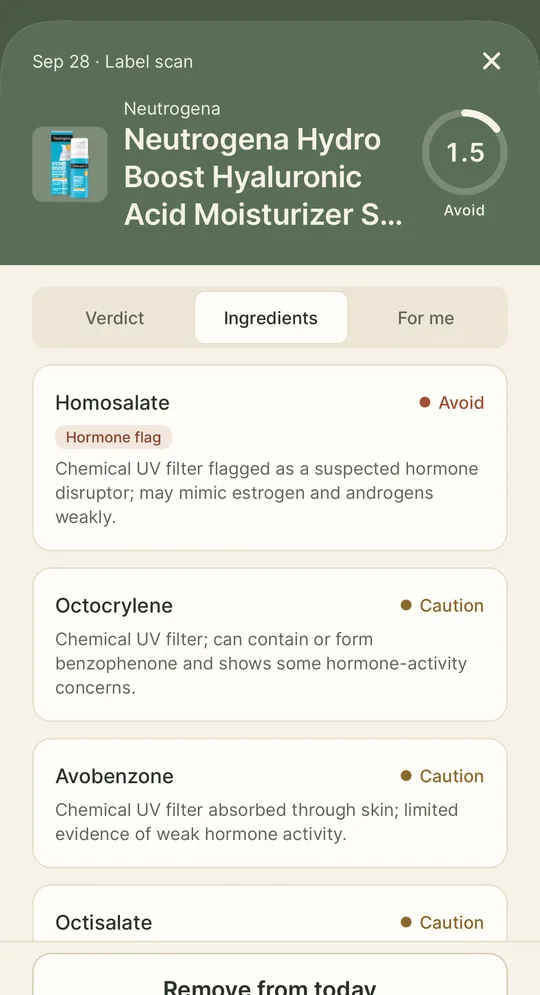
Every checker does the same three things, whatever it calls itself (ingredient decoder, cosmetic ingredients analyzer, beauty product checker):
- Reads the list. Ingredients are written as INCI names, the standardized labeling names, roughly in order of how much the product contains.
- Matches each name against a rulebook. This is the part that matters. A checker is only as good as the sources behind its rules.
- Sums it up. Usually a score or a verdict, plus the specific ingredients that drove it.
The summary is the convenient part. The ingredient-level reasons are the useful part. If a checker gives you a score but not the ingredient behind it, you can’t judge it for yourself.
What should a good ingredient checker flag?
Different checkers answer different questions. Some score overall health, some score environmental impact, and some focus on one concern. ToxFree focuses on hormone flags: ingredients that regulators or researchers have linked to endocrine disruption. Those include:
- Parabens, such as methylparaben, propylparaben and butylparaben.
- Phthalates, such as DBP, DEHP and DEP.
- UV filters like homosalate and oxybenzone.
- Triclosan, BHA, the silicone D4, bisphenols, TPHP and PFAS.
- “Fragrance” or “parfum,” because on a US label that one word can stand in for a blend of many chemicals.
In our scans of 133 beauty and personal care products, 65 (49%) had at least one hormone flag. Fragrance was behind 59 of those 65. If you want to see why fragrance shows up so often, read what “fragrance” on a label can hide.
A flag means an ingredient is linked to endocrine disruption or is an undisclosed fragrance blend. It is a reason to look closer, not proof of harm.
Where do the rules come from?
Ask any checker what it bases its flags on. Good answers point to public, dated sources. One of the most useful is the set of EU endocrine disruptor lists at edlists.org, run by the Danish EPA for Belgium, Denmark, France, the Netherlands and Spain and updated at least twice a year:
- List I: identified as endocrine disruptors at EU level, for example butylparaben, DBP and bisphenol A.
- List II: under EU evaluation, for example methylparaben, BHA and triclosan.
- List III: a national authority concluded the ingredient has endocrine-disrupting properties, for example D4.
These lists change. In April 2026, benzyl salicylate, benzophenone-4 and butylparaben were removed from List II after EU safety reviews (butylparaben stays on List I), and sodium fluoride was added. A checker that never updates its rules drifts out of date. Our guide EU endocrine disruptor lists explained goes deeper.
How do you check ingredients in makeup and skincare yourself?
You can do what a checker does by hand. It takes longer, but it works for a product or two.
- Read the first five ingredients. They make up most of the formula.
- Scan the whole list for the flags above. Fragrance and parfum are the most common by far.
- Look up anything unfamiliar on edlists.org, which has a search box.
- Check the brand’s own page, not a retailer listing. Formulas change, and store pages lag behind.
That last step catches more people than you would think. CeraVe Daily Moisturizing Lotion was reformulated. CeraVe’s own site now lists phenoxyethanol and no parabens, while Ulta’s listing in October 2026 still showed methylparaben and propylparaben. The current formula scores 6.5 out of 10. A checker that pulls from an old database would get that product wrong; reading the label on the bottle in your hand gets it right.
For the full routine, see how to check if a product is non-toxic.
What does a checked label look like?
Two moisturizers from our scans show the difference a few ingredients make. Formulas change; check the label on the bottle you buy.
- Jergens Original Scent Dry Skin Moisturizer: the label lists methylparaben, ethylparaben and fragrance. It scored 4 out of 10, Mixed.
- Neutrogena Hydro Boost Water Cream Fragrance Free: no hormone flags. It scored 8 out of 10, Clean.
Both are moisturizers. The difference is in the list, which is exactly what a makeup ingredient checker or skincare checker is built to surface.
Which products should you check first?
Start with what you use every day and leave on your skin. In our data, the categories differed a lot:
- Dry shampoo: 10 of 10 had a hormone flag, all for fragrance.
- Body care: 14 of 16 contained fragrance.
- Sunscreen: 5 of 6 contained homosalate.
- Lip products: 7 of 14 contained fragrance.
- Mascara: 0 of 10 had a hormone flag.
These were best-sellers we chose to scan, not a random sample of the market, so treat them as a guide to where to look, not a ranking of every product on the shelf.
When is an app worth it over checking by hand?
Checking by hand is fine for one product. It gets slow across a bathroom shelf, and “fragrance” and long chemical names are easy to skim past. A cosmetic ingredient checker app helps with speed, because you get one verdict instead of a long list; consistency, because every product is held to the same rules; and freshness, when it reads the label you photograph instead of an old listing.
Whichever tool you use, it is a shortcut, not a verdict. If you are pregnant or managing a condition, talk to your doctor.
If you want to check ingredients in cosmetics without doing it line by line, ToxFree scans the label and gives a score from 0 to 10 with every hormone flag named. You can also see how it compares with Yuka, Think Dirty and Switch Natural.
Sources
- EU endocrine disruptor lists (edlists.org)
- Commission Regulation (EU) 1004/2014 (propyl- and butylparaben)
- ToxFree scans of 133 products, September 23 – October 5, 2026, re-scored October 6, 2026. Scores are 0–10 from the ToxFree app. A hormone flag means the label lists an ingredient regulators or researchers have linked to endocrine disruption, or an undisclosed fragrance blend.
Check your own products. Scan a barcode or ingredient label with ToxFree to get a 0–10 score and see every hormone flag.
Educational information, not medical advice. Formulas change, so check the label on the product you buy.