 ToxFree
Non-Toxic Sunscreen: Chemical vs. Mineral, Explained
Keep wearing sunscreen. That’s the most important sentence in this article, and the FDA and dermatologists say the same. Everything below is about choosing a non-toxic sunscreen, not whether to wear one.
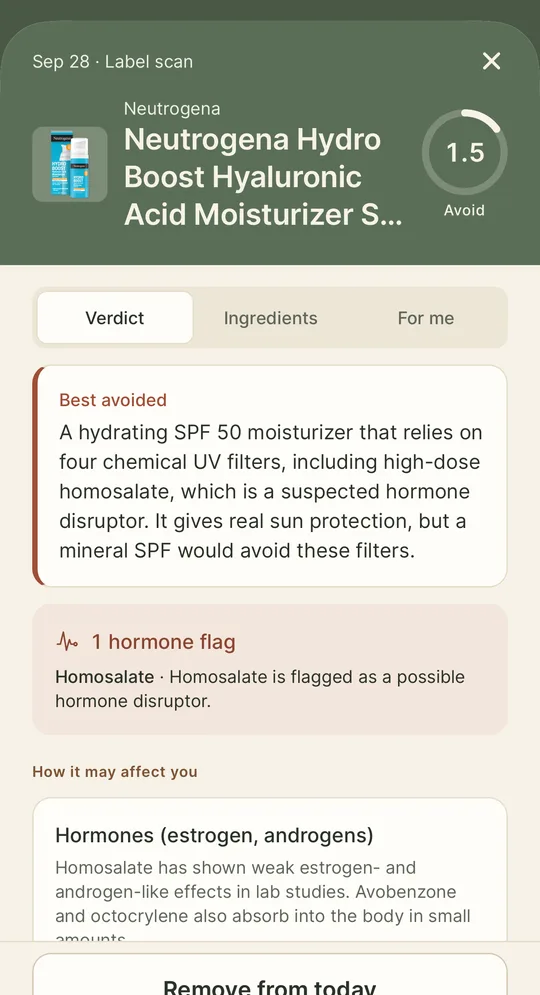
Sunscreen was the lowest-scoring category in our scans. We scanned 133 beauty products between September 23 and October 5, 2026, and re-scored them on October 6. Our six chemical sunscreens averaged 1.8 out of 10, and 5 of the 6 contain homosalate.
Scores are 0–10 from the ToxFree app. A hormone flag means the label lists an ingredient regulators or researchers have linked to endocrine disruption. A flag is a reason to look closer, not proof of harm. These are best-sellers we chose to scan, not a random sample.
Why homosalate gets flagged
Homosalate is a chemical UV filter. In the EU, regulators have taken a harder look at it: after the EU safety committee (SCCS) found the old 10% limit unsafe, Regulation (EU) 2022/2195 now limits it to 7.34%, and only in face products. US sunscreens can use up to 15%.
One example from our scans: Neutrogena Hydro Boost Hyaluronic Acid Moisturizer SPF 50 lists homosalate as an active ingredient (the percentage differs by label revision, so check yours) and scores 1.5 out of 10, an Avoid. Formulas change; check the label on the bottle you buy.
Oxybenzone (benzophenone-3) is another UV filter on the app’s list. The EU limits it to 6% in face, hand and lip products and 2.2% in body products (Regulation (EU) 2022/1176). It also appears on the EU endocrine disruptor lists as under evaluation (List II) and as concluded by a national authority (List III).
What the FDA says
In 2019, the FDA proposed a rule on sunscreen ingredients, and the 2021 proposed order repeated it. Only two ingredients, zinc oxide and titanium dioxide, were proposed as “generally recognized as safe and effective” (GRASE). Twelve filters, including homosalate, oxybenzone, avobenzone, octocrylene, octisalate and octinoxate, were listed as needing more safety data.
Then came the absorption studies. FDA researchers published two studies in JAMA, in 2019 and 2020. In them, avobenzone, oxybenzone and octocrylene, and in the 2020 study homosalate, octisalate and octinoxate, reached blood levels above 0.5 ng/mL. That is the threshold at which the FDA asks for more safety testing.
Read that carefully. Above the threshold is not the same as proven harmful. It means the filters get absorbed and the safety data is still incomplete. The FDA and dermatologists still say to use sunscreen.
The mineral option for a non-toxic sunscreen
Zinc oxide and titanium dioxide are the two filters the FDA proposed as GRASE. They’re the mineral filters. If you want to avoid homosalate, oxybenzone and the other flagged filters, mineral sunscreen is the cleanest path.
When you shop:
- Read “Active ingredients.” You want zinc oxide and/or titanium dioxide, and no homosalate, oxybenzone, octocrylene, avobenzone, octisalate or octinoxate.
- Check the inactive list for fragrance. It’s the most common hormone flag in our whole dataset. See What “fragrance” on a label can hide.
- Don’t rely on “clean” on the front. The term has no legal definition for cosmetics. The active ingredient list is the part that counts.
- Apply it generously and often. The best sunscreen is the one you’ll actually wear.
If you’re not ready to switch
Switching everything at once isn’t necessary. Here’s a reasonable order:
- Start with the sunscreen you use on your face every day, since that’s the large, daily exposure.
- Then change the one you use on your body.
- Use up what you have rather than skipping sun protection in the meantime. Wearing a chemical sunscreen is better than wearing none.
If you’re pregnant, nursing, or managing a skin condition, ask your doctor which sunscreen is right for you. This isn’t medical advice.
For the full scan results, see We scanned 133 beauty products. To build sunscreen into a wider routine, see a non-toxic skincare routine.
What “chemical” and “mineral” mean on the label
The label’s “Active ingredients” box is the only reliable way to tell. If it lists homosalate, oxybenzone, avobenzone, octocrylene, octisalate or octinoxate, it’s a chemical formula. If it lists zinc oxide or titanium dioxide, it’s mineral. Check the box on the exact product you’re holding, since a brand’s SPF lotion, stick and spray can each carry different filters.
The five homosalate sunscreens in our scans also listed other filters from the FDA’s “needs more data” group. That’s the main reason the whole category averaged so low: the score reflects the full active ingredient list, not homosalate alone.
Sources
- FDA proposed sunscreen rule (2019)
- FDA absorption study, JAMA 2019 (PubMed)
- Commission Regulation (EU) 2022/2195 (homosalate)
- EU endocrine disruptor lists (edlists.org)
- ToxFree scans of 133 products, September 23 – October 5, 2026, re-scored October 6, 2026
Check your own products. Scan a barcode or ingredient label with ToxFree to get a 0–10 score and see every hormone flag.
Educational information, not medical advice. Formulas change, so check the label on the product you buy.