 ToxFree
A Non-Toxic Skincare Routine: Morning, Night, Priorities
A non-toxic skincare routine doesn’t need ten steps or a shelf of new bottles. It needs the right order and a quick label check on the products you use most.
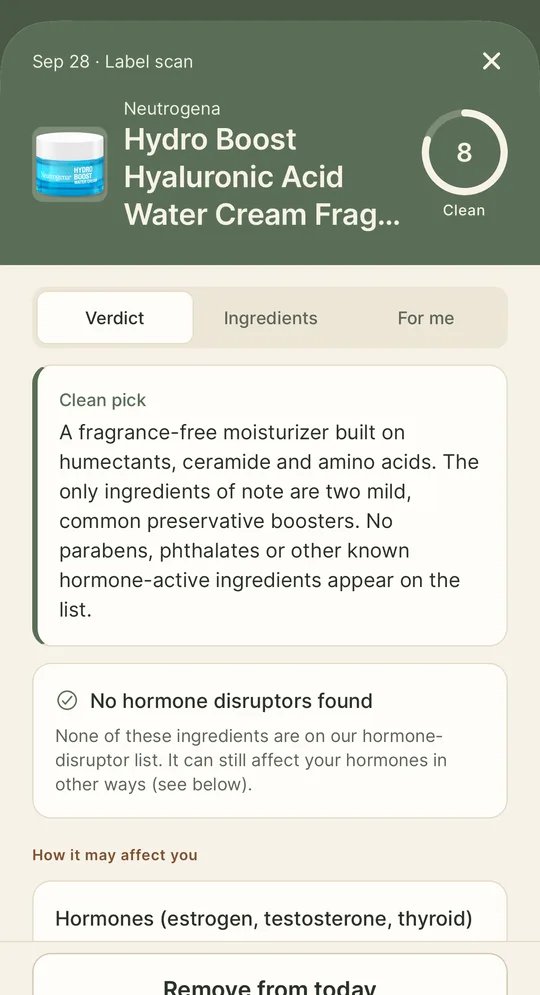
Good news from our data: face skincare was our cleanest category. We scanned 133 beauty products between September 23 and October 5, 2026, and re-scored them on October 6. Of 33 face skincare products, 14 scored Clean, the average was 6.0 out of 10, and only 6 had a hormone flag.
Scores are 0–10 from the ToxFree app. A hormone flag means the label lists an ingredient regulators or researchers have linked to endocrine disruption, or an undisclosed fragrance blend. A flag is a reason to look closer, not proof of harm. These are best-sellers we chose to scan, not a random sample.
A non-toxic skincare routine, in order
Morning
- Cleanser (or just water, if your skin is dry).
- Serum, if you use one.
- Moisturizer.
- Sunscreen, always last. Don’t skip it; see Non-toxic sunscreen.
Night
- Cleanser, or a makeup remover first if you wear makeup.
- Treatment or serum, if you use one.
- Moisturizer.
That’s it. Three to four steps is plenty for most people, and fewer products also means fewer labels to check.
Which steps matter most
You can’t scrutinize everything equally. Prioritize by three questions: Is it left on the skin? Does it cover a large area? Do you use it every day?
- Leave-on products first. Moisturizer and sunscreen stay on all day. A cleanser is rinsed off.
- Sunscreen is the highest priority. Our six chemical sunscreens averaged 1.8, and 5 of 6 contain homosalate. A mineral formula with zinc oxide or titanium dioxide avoids that.
- Moisturizer is the daily workhorse, so it’s worth a label check.
- Rinse-off products last. Less contact time means lower priority.
What our face skincare data shows
The flags in face skincare were mostly one thing. The 6 flagged products listed fragrance, and one of them, Jergens Original Scent Dry Skin Moisturizer, also lists methylparaben and ethylparaben (4 out of 10, Mixed). Fragrance is the single easiest thing to avoid: look for “fragrance-free” on the front, then confirm no “fragrance” or “parfum” appears in the list. “Unscented” can mean a masking fragrance was added to cover base smells, while “fragrance-free” means none was added (essential oils can still add scent). More in What “fragrance” on a label can hide.
The cleansers, makeup removers and wipes we scanned (11 products) averaged 6.3, and only 2 of 11 had a hormone flag, both fragrance. Two scored Clean: Neutrogena Hydro Boost Fragrance-Free Gel Facial Cleanser and Aveeno Calm + Restore Nourishing Oat Facial Cleanser, both 7 out of 10.
Products that scored Clean in our scans
If you want somewhere to begin, these scored 7 or 8 out of 10 with no hormone flags:
- Moisturizers: Aveeno Daily Moisturizing Cream (8), Neutrogena Hydro Boost Gel Cream Fragrance Free (8), Neutrogena Hydro Boost Water Cream Fragrance Free (8), CeraVe Ultra-Light Moisturizing Gel (8), Dermalogica Stabilizing Repair Cream (8)
- Cleansers: Neutrogena Hydro Boost Fragrance-Free Gel Facial Cleanser (7), Aveeno Calm + Restore Nourishing Oat Facial Cleanser (7)
- Soothing balm: La Roche-Posay Cicaplast Baume B5 (7)
Brand didn’t predict much. Neutrogena has products near the top of our list and a sunscreen near the bottom. Judge the product, not the brand. Formulas change; check the label on the bottle you buy. We saw this with CeraVe Daily Moisturizing Lotion, whose own site now lists no parabens while a retailer’s listing still showed two.
A simple way to start
- Check your sunscreen and moisturizer first.
- Swap in fragrance-free versions when a product runs out.
- Add steps only if you have a reason. Every extra product is another ingredient list.
The full method is in How to check if a product is non-toxic. If you’re pregnant or managing a skin condition, ask your doctor before changing products; this isn’t medical advice.
Where fragrance hides in a routine
In our scans, fragrance accounted for every flag in cleansers and for all six flagged face products (one of them also had parabens). It’s easy to miss because it isn’t always obvious: the product may look plain and still list “parfum” near the end. Check the leave-on products first. Then check anything else you use daily, since that’s where repeated exposure adds up. Of the body care products we scanned, 14 of 16 listed fragrance, so it’s worth checking those as well, although they sit outside a face routine.
Sources
- EU endocrine disruptor lists (edlists.org)
- Commission Regulation (EU) 2022/2195 (homosalate)
- FDA sunscreen proposed order (2021)
- ToxFree scans of 133 products, September 23 – October 5, 2026, re-scored October 6, 2026
Check your own products. Scan a barcode or ingredient label with ToxFree to get a 0–10 score and see every hormone flag.
Educational information, not medical advice. Formulas change, so check the label on the product you buy.